
Greetings and sejunction! You know, keeping some distance is often a good thing! Anyway, welcome to my blog, where today's topic is flags! Everyone loves designing them, but what makes a good flag? Let’s find out!
Raise your flag… what?
Let’s start with what I often do: a definition!
A flag is a piece of cloth, usually rectangular, used to represent a group of people.
And that is it! At least I think it is. And you all know me, I prefer rather wide definitions and then subgroups.
I say mostly rectangular because historically, it has been much easier to do rectangular shapes rather than…

Whatever you call this abomination of a shape. Imagine doing that 2-4 hundred years ago.
Rules of Vexillology
Vexillology is the study of flags, and they have 5 rules for good flag design, so I will use them. Why reinvent the wheel, am I right? Just for honesty sake, I will be using AI generated flags in order to not shit on people's real flags that they might like, regardless of how poorly designed they are.
So on we go!
1: Keep It Simple (Stupid)
A flag should be simple, and I mean REALLY simple. A rule of thumb I have heard is that it should be so simple that a 7-year-old can draw it from memory and get it right.
Now, why should it be that simple, one might ask? Well… because it is a piece of cloth flapping in the air, and as it flaps around, it deforms and twists. So if you have something complex on it, it will be hard to see what it is trying to show. If it is sufficiently complex, it is impossible to ever see it fully because of how it flaps in the wind.

Look at this one. Sure, it is incredibly pretty and everything. But if you saw it twisted in the wind, could you make anything out? Maybe the stars on the sides, but everything else would be difficult.
And can you imagine a 7-year-old drawing this? You would get the 4 stars, some curly for the thick one, and then maybe, if they remember, just drawing their crayon around randomly. It is simply too complicated; if you remove it from my sight, I could not remember anything but 4 stars, a spiral, and scribbling of lines.
2: Meaningful Symbolism
As I said in my ritual post–and I think others, but rituals are fresh in my mind–symbolism is important. It binds people in the past, present, and future together and gives things a story; humans are story creatures.
So everything in the flag should have some symbolic meaning. The colours, the shapes, everything should have it. Let’s look at the flag below!
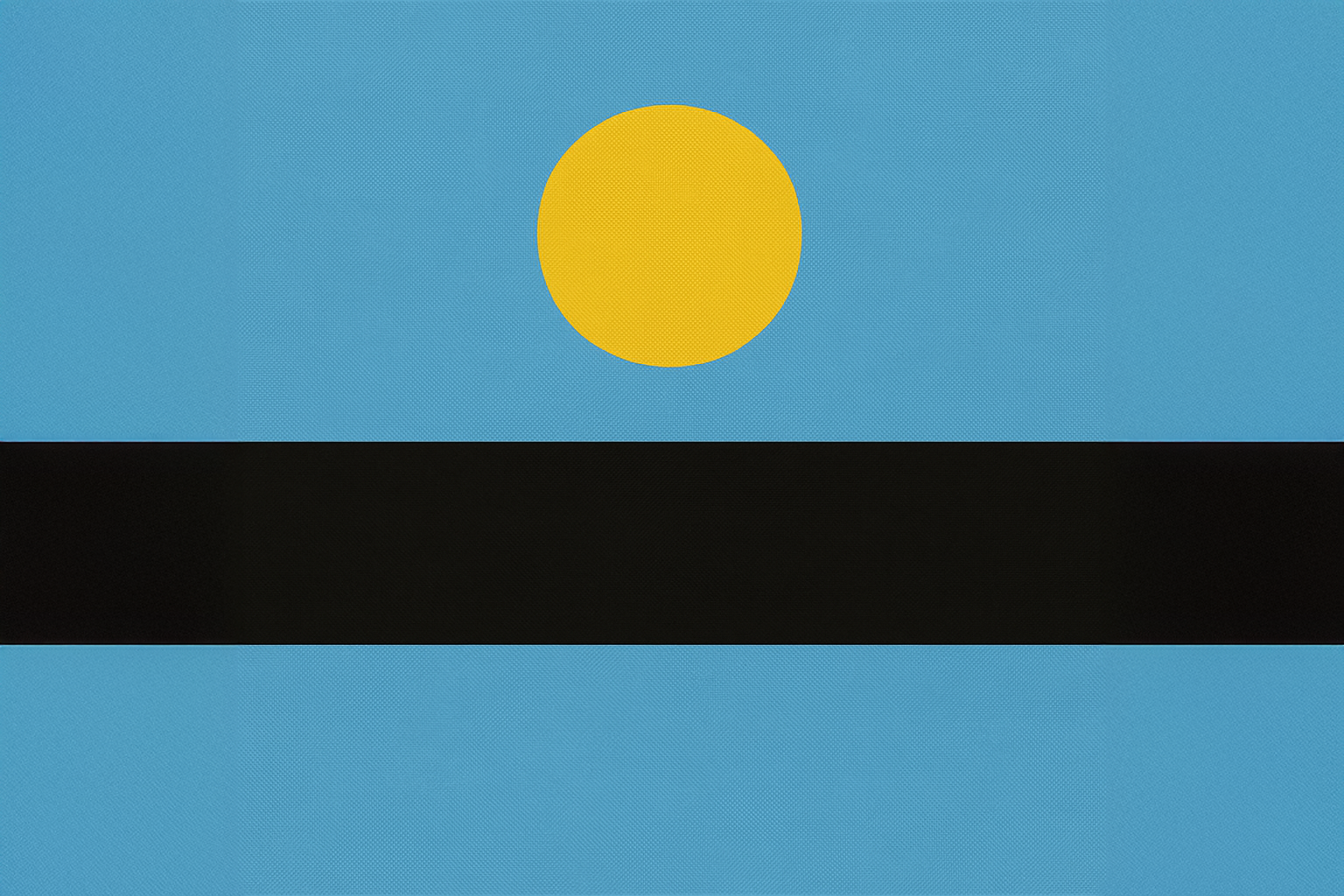
Yeah, it is AI-generated to break this rule, and we can imagine it having “meaning,” but what could it be? The circle can obviously mean the sun, but the sun is rather generic. You need to think about what the sun is meant to mean. In Japan, they were called “the land of the rising sun,” and the sun had a long history of being especially significant to them, so using the sun makes sense.
We can figure the blue is probably sky at the top, but what about at the bottom? Maybe the ocean, but then what is the black? It just feels completely out of place there. Humans generally associate black and darkness with negative things, so it looks odd here.
3: 2-3 base colours
This one is the one I see the most frequently broken on flags—the overabundance of colours. You should only have 2-3 colours, 4 maybe, 5, you are stretching. After that, there are always too many. But why so few colours? Again, the flag is flapping in the wind, and having lots of colours makes it difficult to make out what it is. Fewer colours means colours can visually be kept separate and very distinct. Many colours mean they will start getting too close to each other.
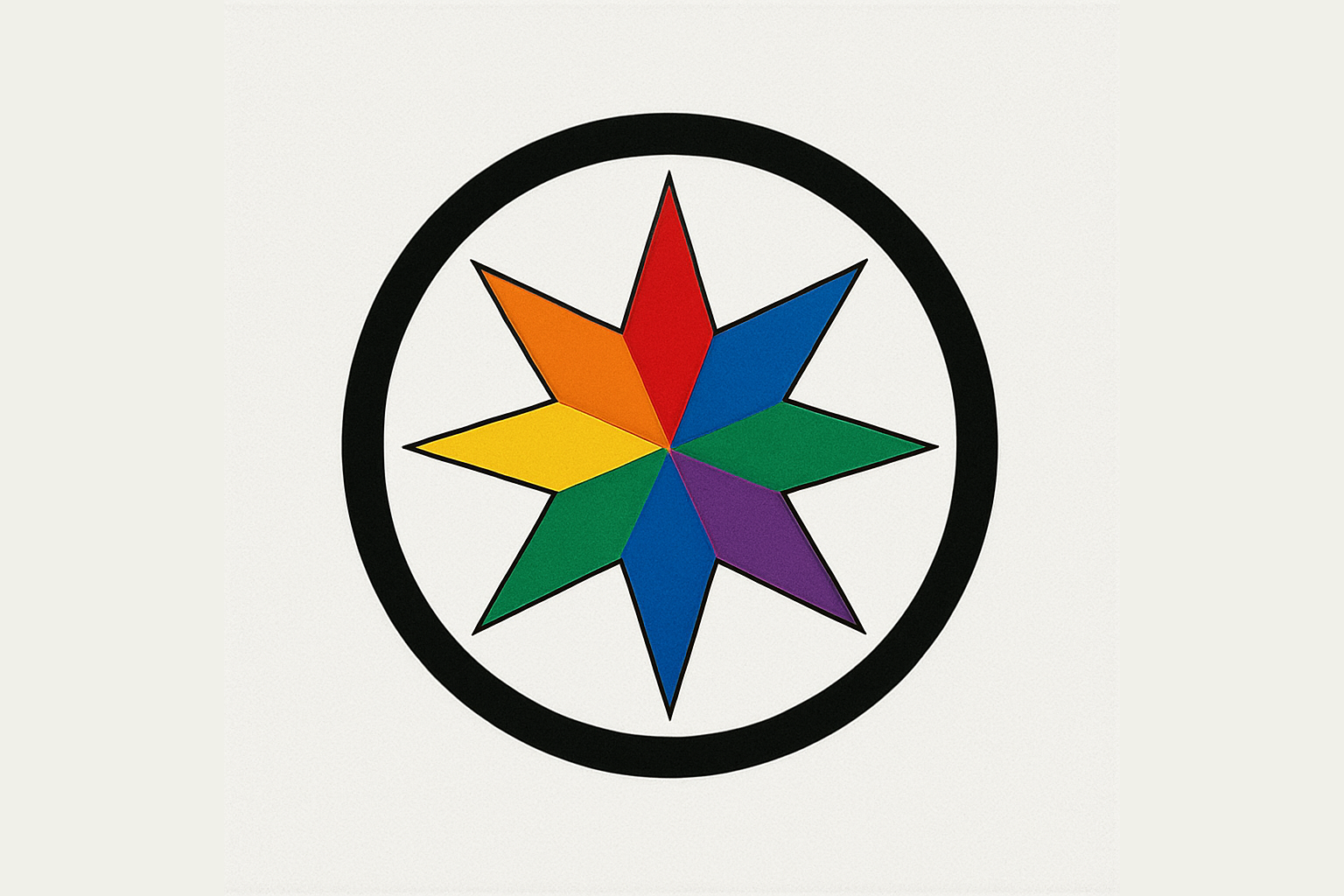
Look at this one. Symbolically, it is very simple and good, but the huge array of colours at the very centre is a problem. Blue and green easily blend together, and so does purple with blue. It would be much better and easier to see if it had been a single colour. It kind of hurts my eyes to see this one if I am honest. This is honestly my biggest qualm with a certain collection of flags, far too many colours!
4: No lettering or seals
It’s a flag, not an information pamphlet. When I look at a flag, I shouldn’t have to try to read some information as it flaps in the wind. How am I supposed to do that when half the letters are only visible at the best of times?
Seals are great… as seals. Seals are terrible for flags! Seals are almost always incredibly complicated, thus violating the first rule to begin with. And they often have many colours, meaning they violate the previous rule as well! Do NOT add seals to your flag!
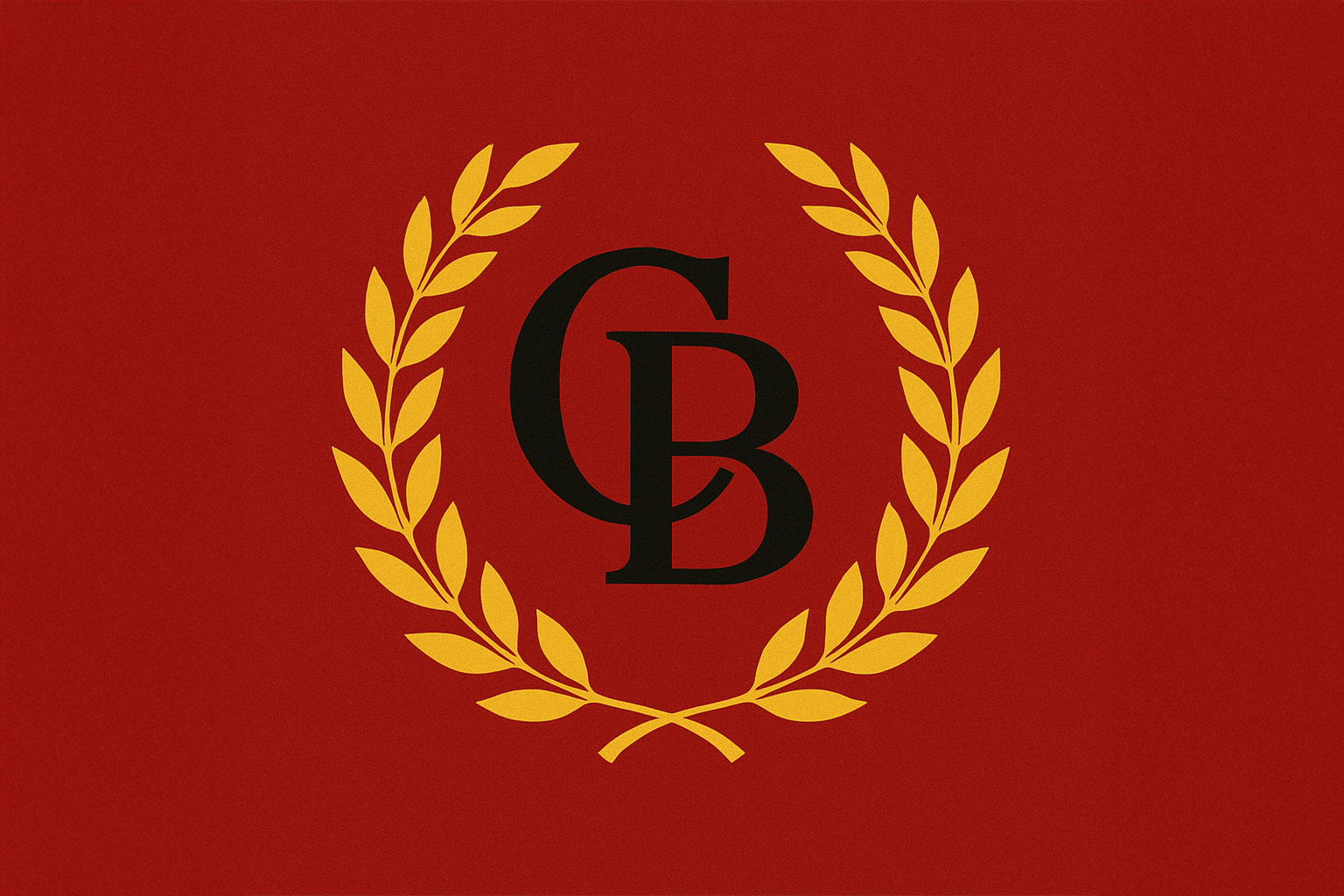
Here we have the CB in it. This requires one to know the Latin alphabet to begin with, and then also understand what it can stand for Commonwealth Busty or something, I don’t know! It isn’t meaningful symbolism because letters are not viewed as symbols in this case. Sure, if you have a VERY stylised letter that is only used in a specific context, then yeah, that font is symbolic and it can be fine to use, but then it is the style itself, not the letter per se.
5: Be distinct or be related.
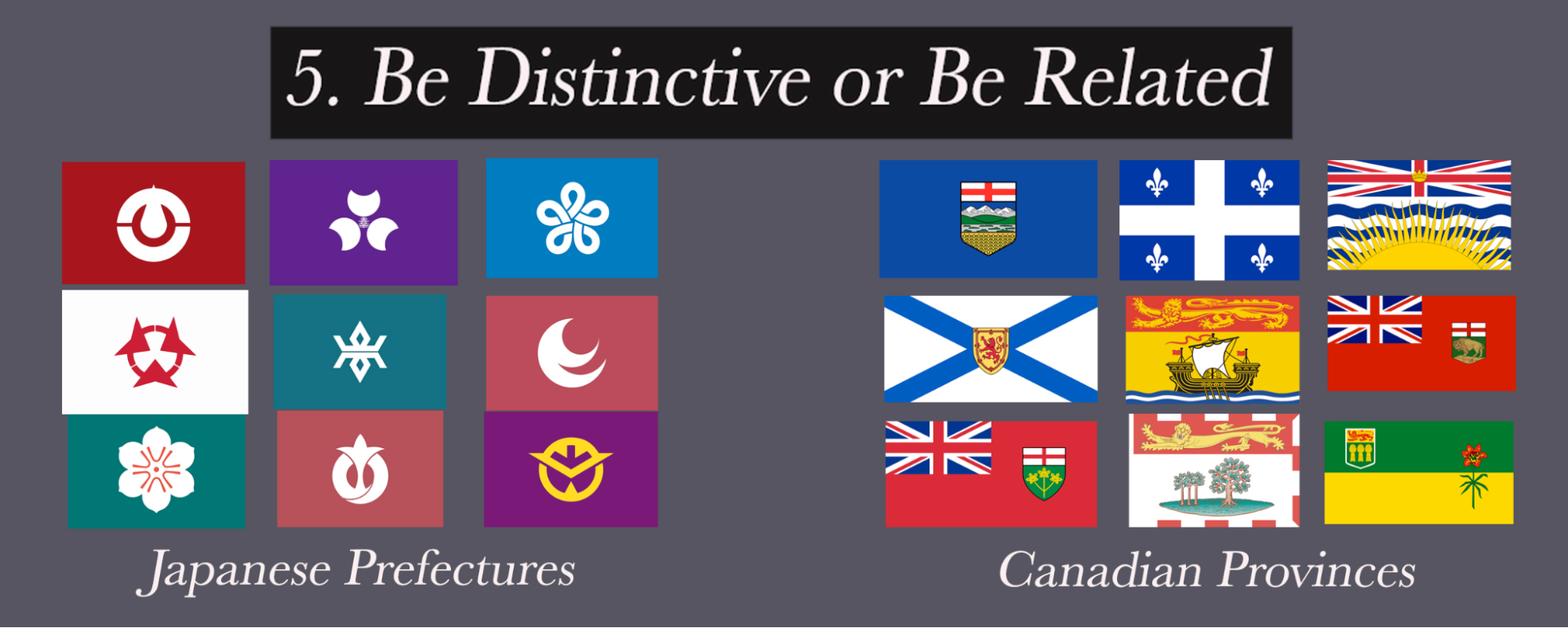
The flag's job is to identify a group of people. So it should be distinct to be identifying. But people are in groups that are in bigger groups, which are part of even bigger groups! It is like a Russian doll of groups! So if you do many flags, you need to balance similarity and dissimilarity depending on how people group themselves.
Like we Nordic countries have our cross on the flag to unite us, but they are all colours and style-wise distinct enough that you wouldn’t conflate them. And unlike before, I won’t use an AI flag because that requires too many, and it wouldn’t make them similar/dissimilar enough to make my point.
https://u.osu.edu/flagdesign/flag-design-principles/
The Japanese prefectures are all distinct; you wouldn’t easily conflate them, but at the same time, you see there is a coherent style that ties them all together. They truly look like they all belong to a super group of unified people who are together.
Canadian provinces look more like they were a bunch of different countries with no clue what they were doing. They have nothing that unifies them, and at the same time, due to their complexity, they blur together and stop being distinct. 3 of them have the Union Jack as part of it, and like 6 have parts of it somehow, and then others are completely absent.
Breaking the rules
Anyone who knows me and my propensity for rules–see my post on rules for worldbuilding!–knows that while I like rules, they are never absolute, and neither should all these rules I have given, despite them not being mine. So, when should you violate the rules?
Well, when it serves a very specific purpose. Like, if the symbolism is so important and great, it is okay to violate the colour rule because the symbolism is so much more important. As much as I smack on the pride flags for their designs, if we go to the original:

7 colours are WAY TOO MANY! But you know what? That is okay. The symbolism here of the 7 colours of the rainbow–which is entirely fictitious and was made by Isaac Newton, who made it 7 because of his numerology beliefs, but it got stuck in the communal consciousness. Anyway, showing the rainbow and the spectrum of human existence in it outweighs the fact that the colours make it a bit of an eyesore, and too many colours.
Anything can work if you do it very carefully, but I would definitely say this as a stronger rule of thumb: break only one of the rules if you are going to break any of them. And make sure that you break it with great intent.
Vivian’s Flags
With this, why don’t we look at some flags I’ve designed and my thought process behind them?
Raixhen Empire
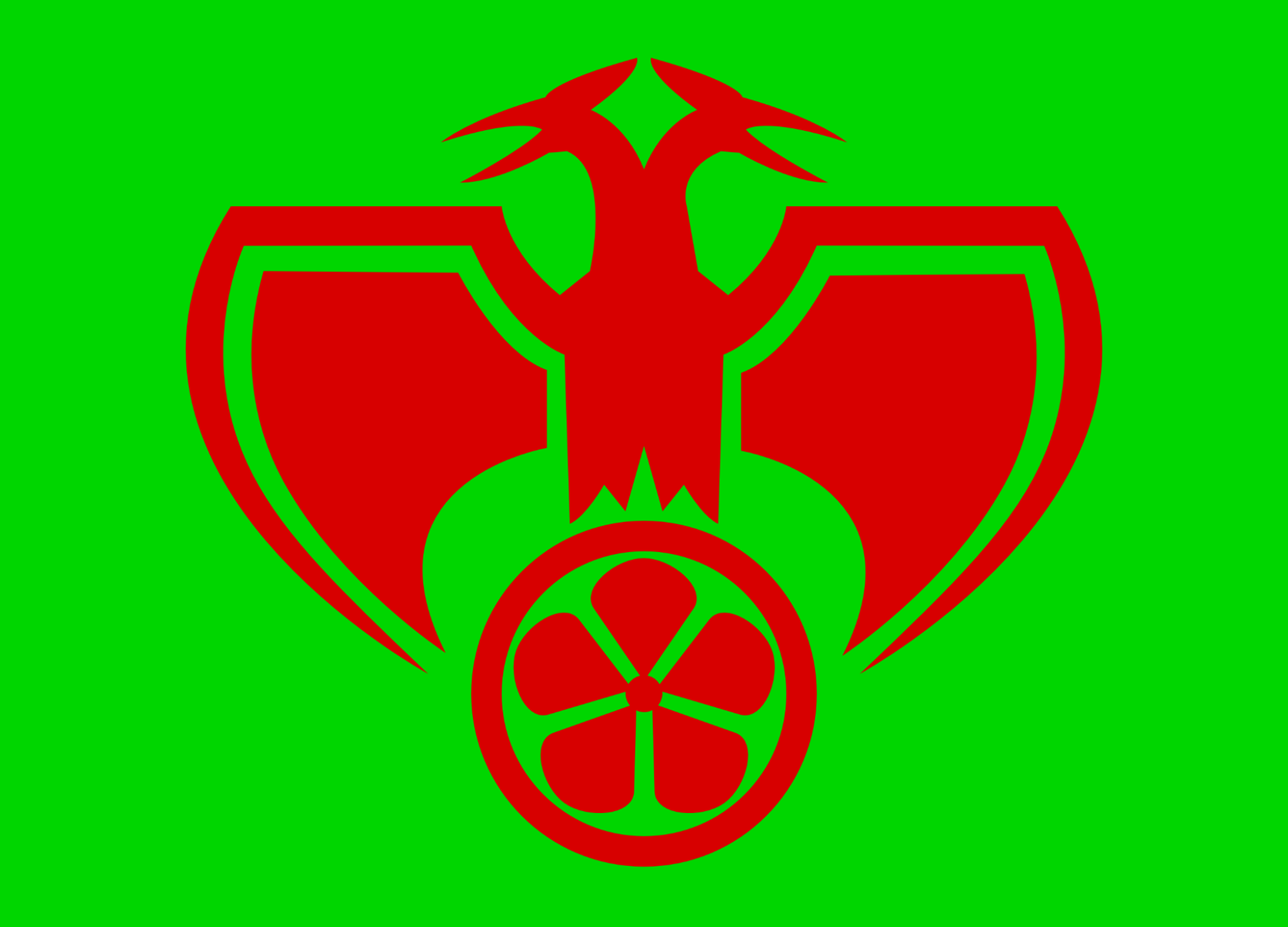
This is the design for the Raixhen Empire flag. The green comes because they are planimals, plant-animal hybrids, and the red represents the colours of their and many flowers that bloom, once again enhancing the motive of their plantness that they pride themselves on in a galaxy dominated by animals.
The creature is a double-headed pterodactyl-like being. It’s not really two-headed in life, but it is like the double-headed birds and dragons that have been used. It stands upon the Imperial flower to show it is the might of the empire.
It is a bit complicated in its design, I will grant you that, but the idea is rather easy: winged creature, two heads, standing on a flower.
Divine Dominion
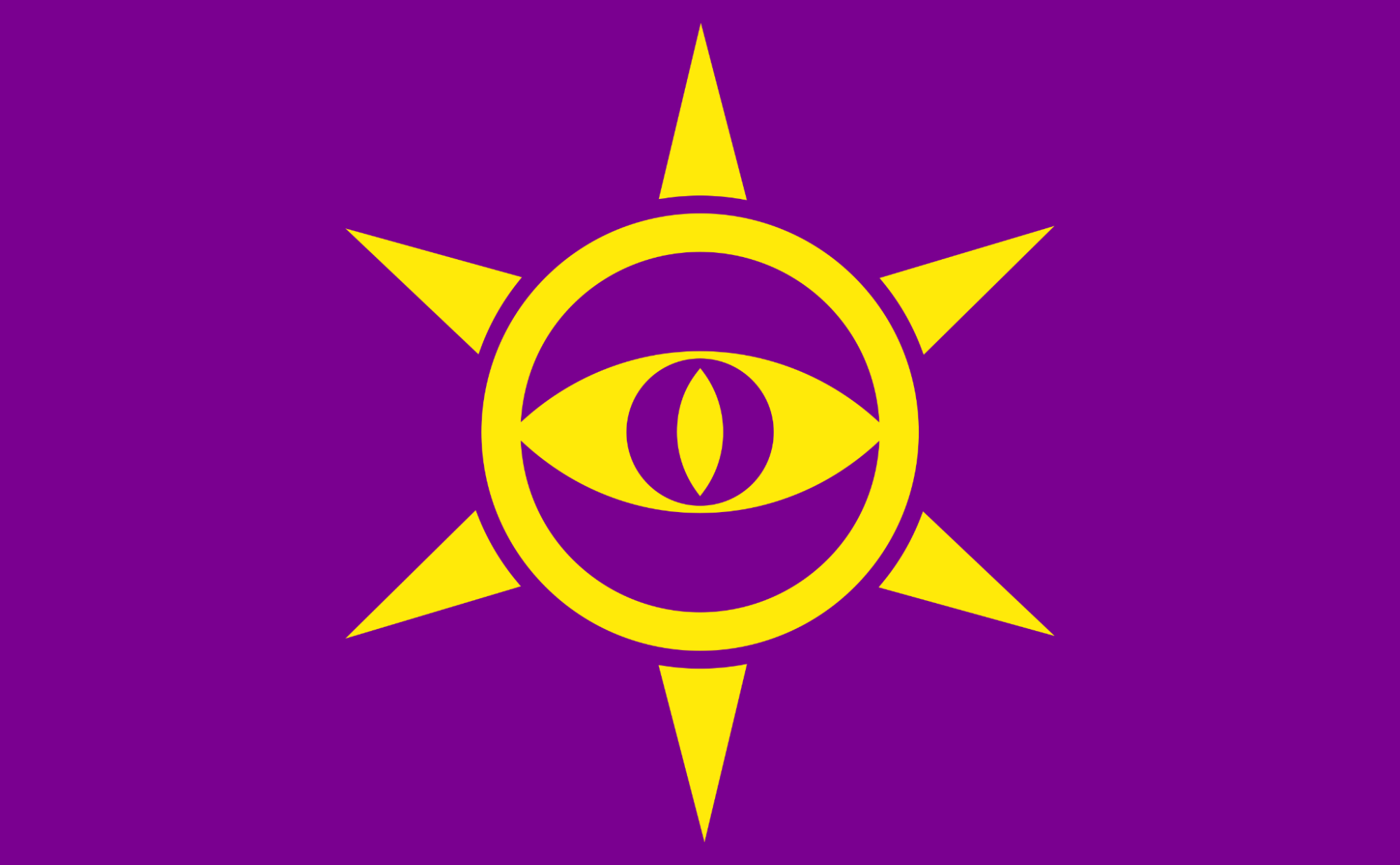
The colours here come from their own colours, where the purple limaces tend to be the ruling class. One could think the other colour would be pink because their supreme ruler is purple and pink, but no, it is yellow to symbolise the importance of their faith as they associate yellow with faith, religion, and such experiences.
The symbolism is an omnituent eye that is looking out. As they portray their deity, Divinum, as all-seeing, to remind viewers that their ruler, albeit in the flesh, is all-seeing and sees all. And the ray-like parts are to show that they are among the stars.
Again, the eye is a bit more on the complicated side, but it is an easy idea that a child can grasp: an eye with rays from it, and they can quickly draw it.
Commonwealth of Worlds
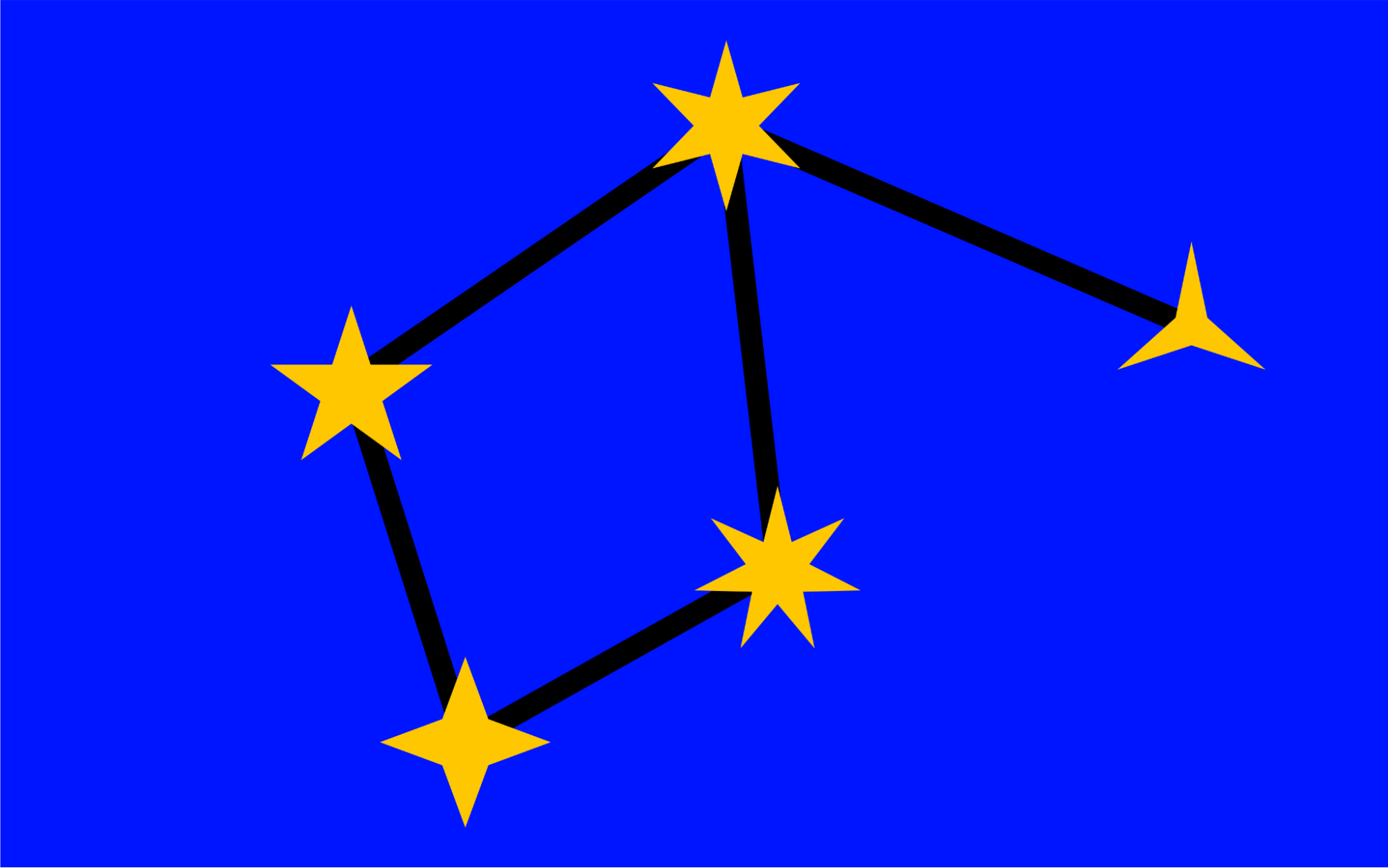
My “Federation,” so to speak. They are all about diversity. Blue is because yellow looks good against it, and yellow because it's normal stars. The lines are to show they are connected, and the different kinds of points on each star are to symbolise the enormous diversity that they house. So the lines and different stars are meant to symbolise their unity through diversity.
Duarchy of Fungi

The Duarchy has, as the name suggests, two leaders, but they rule together as one. So they have a fungi image growing into two, one for the supreme shaman and one for their monarch. This symbolises their secular and spiritual side working together to rule their domain. The colours I don’t remember, honestly, it just looked good if you ask me.
The Federation of Workers

I do have a federation also! The United Federation of Workers’ Unions! The red is socialism because they are a socialist people. Why would they use red for it also? They wouldn’t, sensibly, but this is for Earth people, and we have that association, so I am importing it! The 8-pointed stars are for their hands, which have 4 fingers each. The triangle of the red is to show that the socialism is holding them together against the vastness of the blue sky.
Tshutsi League
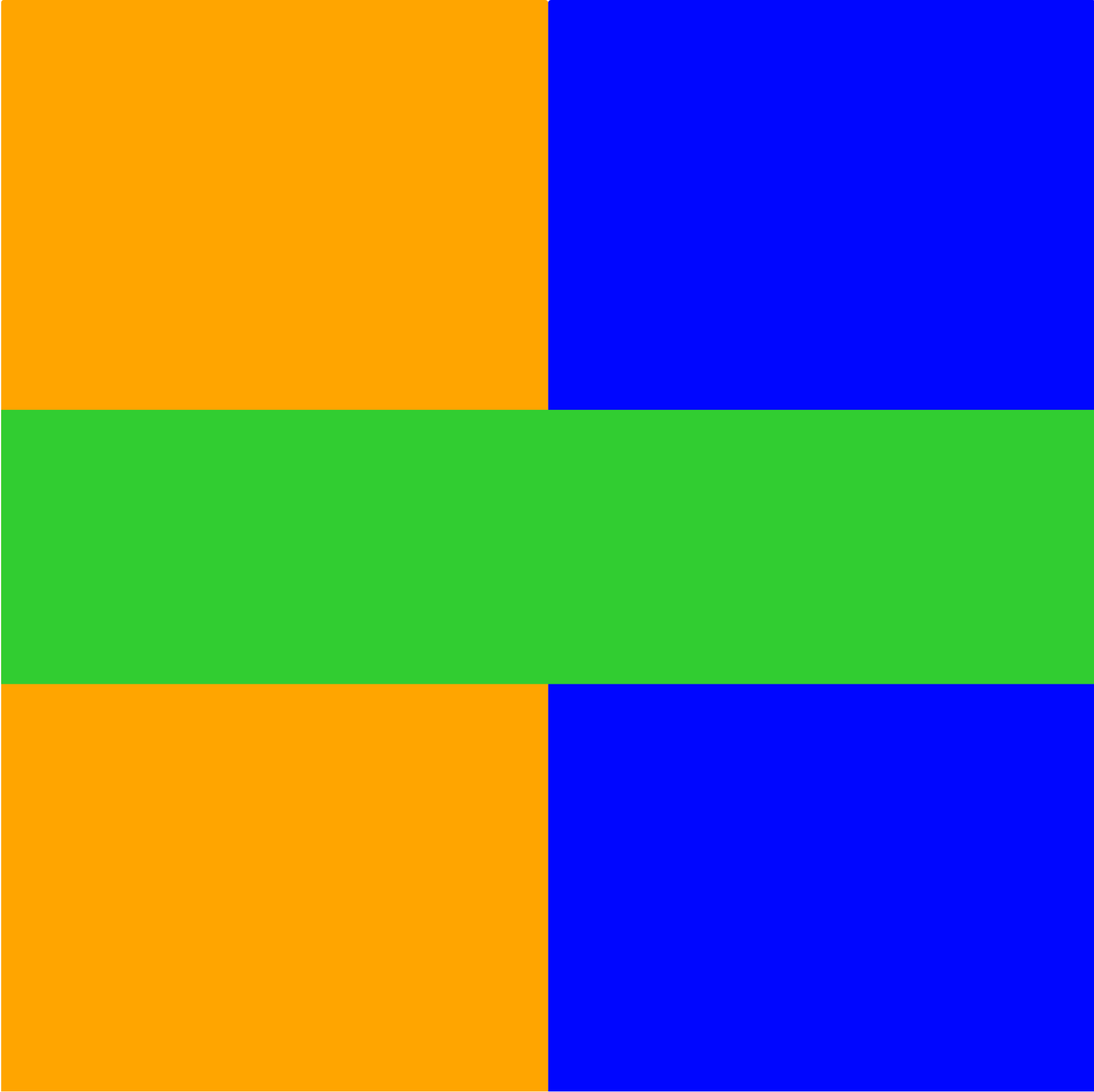
The Tshutsi League: my neutral Switzerland equivalent. The orange and blue originally came from Orange-Blue morality, but ended up looking good and became a good symbol to show two opposite sides that don’t mix. The green was a good mix on top of that; it is, however, across the two others to show that the Tshutsi act as a neutral bridge between sides.
Linathre

The Linathre don’t have a star nation, but they have a flag to unite them. The mountains symbolise the Linathre because they grow, over centuries, to mountain-sized proportions. The yellow background again symbolises the stars, saying they are great and big like the stars, even though they have lost their homeworld to the sands of time.
Sinitti Republics & Dextine Kingdom
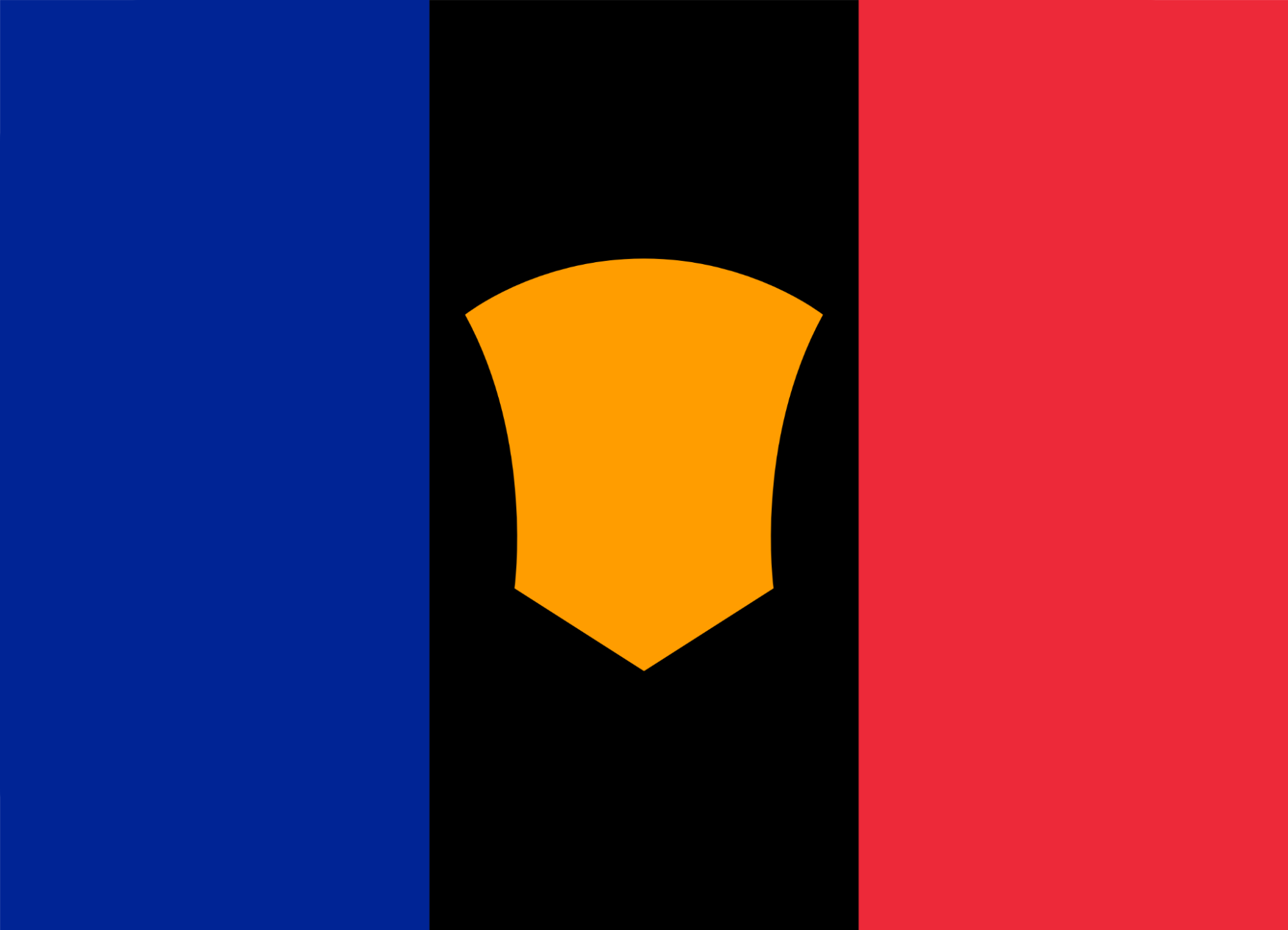
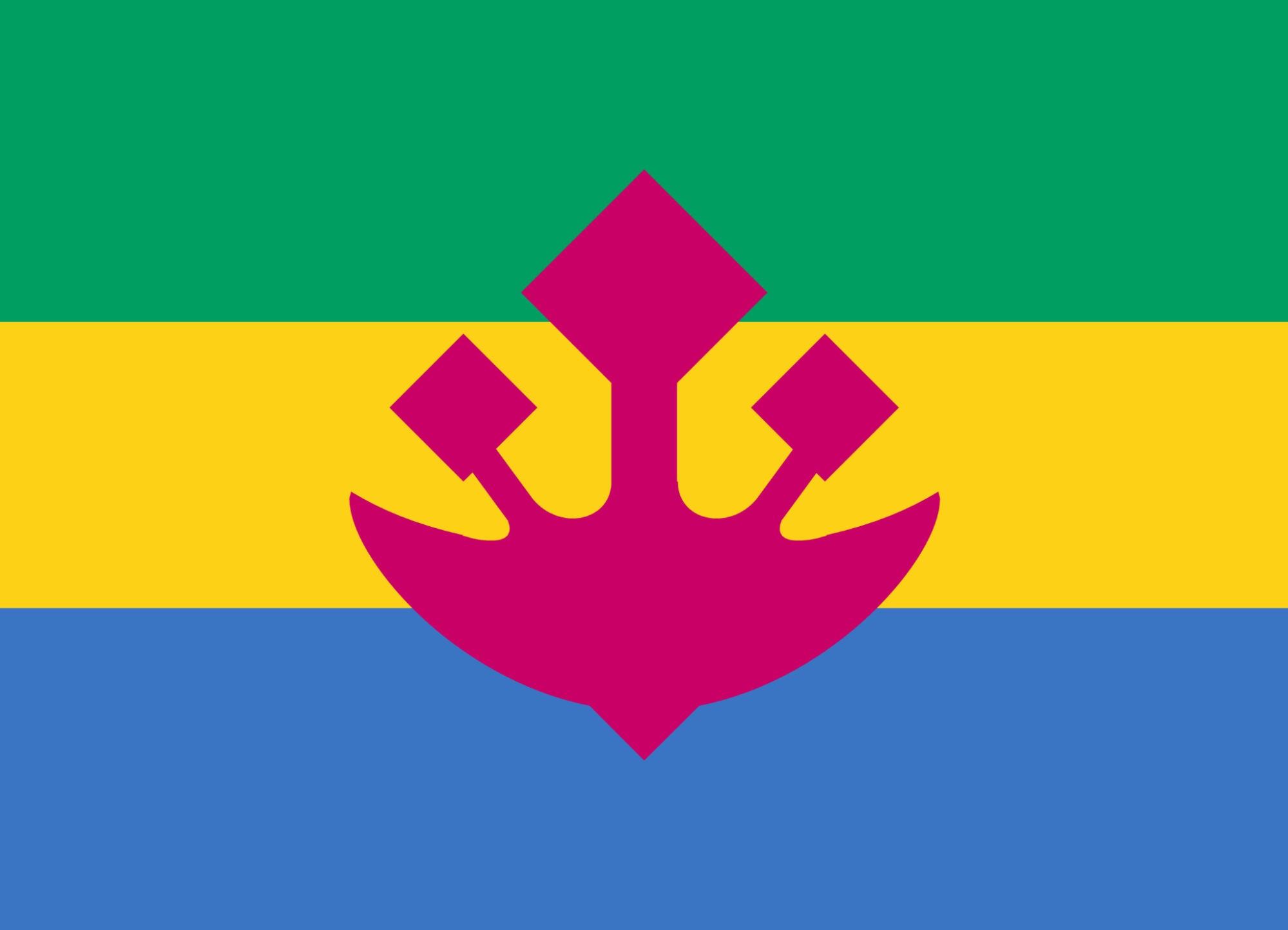
I put them together because I do not remember any of the colour symbolism. The shield is because Sinitii are obsessed with defending themselves against the Dextites.
The symbol on the Dextite flag is meant to symbolise their royal family.
Summa Summarum
When it comes to designing flags, simplicity is your friend, but you can always deviate from it. And as I show on mine, it is fine to go “I have no idea.” You can always work in reverse. Instead of deciding based on what it meant at the time, you can design what looks good and then decide what it symbolises afterward.
And I would say this, when it comes to rule #1: keep it simple, is that it is the concept/idea of the flag that counts as simple, not the actual design. If you know the Dominion flag above, no matter how you draw the eye, you will think it is the Dominion flag with the right colours and the rays. So while an eye is complicated, the concept is not.
And I think that is all for now, but before we leave, ANNE! Feel like doing a post discussing other fictional flags?
(Anne:)
(Vivian): Oh, sweet Divinum, were you paying attention at all? Hamsters… Bloody hamsters… Well, you've got something to look forward to now!
Want to dive into a discussion about Stellima or the art of writing on Discord? We’d love to have you! And if you have any topics you struggle with or that you would like to suggest for a future blogpost, we’re open to suggestions!
Interested in supporting our work? Join our Patreon and become a part of Stellima as a citizen of Mjatreonn! Or would you like to give us some caffeine to fuel our writing? Consider buying us a coffee at Ko-fi! Every contribution inspires our creativity and keeps us going. Thank you for your support!
Copyright ©️ 2025 Vivian Sayan. Original ideas belong to the respective authors. Generic concepts such as flags, vexillology, and the sample AI-generated flags are copyrighted under Creative Commons with attribution, and any derivatives must also be Creative Commons. However, specific ideas such as the Raixher Empire, the Divine Dominion, the Commonwealth of Worlds, the Duarchy of Fungi, the Federation of Workers, the Tshutsi League, the Linathre, and the Sinitti Republics and Dextine Kingdom and their respective flags, as well as all language or exact phrasing, are individually copyrighted by the respective authors. Contact them for information on usage and questions if uncertain what falls under Creative Commons. We’re almost always happy to give permission. Please contact the authors through this website’s contact page.
We at Stellima value human creativity but are exploring ways AI can be ethically used. Please read our policy on AI and know that every word in the blog is written and edited by humans or aliens.