
Worldbuilding 105: Domesticated Animals & Civilisations
Greetings and Spatiography! Everyone knows I love space! Hence, I write a space opera! But today, we’re not talking about space; we’re talking about things like my lovely sister: domesticated animals! Specifically, what happens when she collides with me, that is, civilization! 😁
This is kind of but not really an expansion of an old post I made on animals and their interactions… That was the first post on the blog… So long ago.
The animal of domesticated
A definition is always lovely. So here we go!
A domesticated animals is an animal that has undergone selective breeding for many generations by a sophont species.
Now what does that mean? Well, a sophont species is a species with a human level of cognition (or meta-cognition). The rest just says that the people took the animal and, for many, many generations, went: “Those individuals are the ones that I want to have babies and those ones I don’t want to have babies.” Not so fun fact: when you apply this to people/sophonts, it is called eugenics!
Utility of domestication
When it comes to early sophonts and people, we can ask ourselves, why the frick would they ever waste what precious little time and energy and food they have on other animals when they barely have enough for themselves?
And that, my astute reader, is the question to ask, and the answer is as simple as it is complicated: because they clearly gained something from it. Let’s run through a few examples, and we’ll start with Anne’s favourite, cats!
As I said in that other post, cute is not enough for an animal to be worth it to Stone Age people, but it is a massive plus. So what made cats worthwhile keeping around? Well, when you started growing crops and had wheat and all that, it had to be stored, and some stuff could be stored for a decent amount of time before it went bad. But you know what attracts large stores of food? RODENTS! Mice and rats started going, “Oh, these hairless monkeys have food stored, let’s go and take it!” and the hairless apes didn’t want that. Cats are very good at catching rodents. So the exchange was simple: cats take care of the rodents, in exchange, we give them food and housing. And most of the time, the cat fixed its own food from the rodents. Then we cutified them because why the frick not?
What about dogs then? They aren’t good against rodents, but they are good at spotting things in the dark that we meet or finding things we cannot see because they can hear better and smell better than us bipedal misfortunes. So wolves became dogs over time because their abilities to find and protect became useful and greatly outweighed the cost of food that we had to do with them. And again, we cutified them because we wanted to. Then we bred some of them into obliteration and now they suffer and those people should be ashamed of themselves.
Next up is piggies!
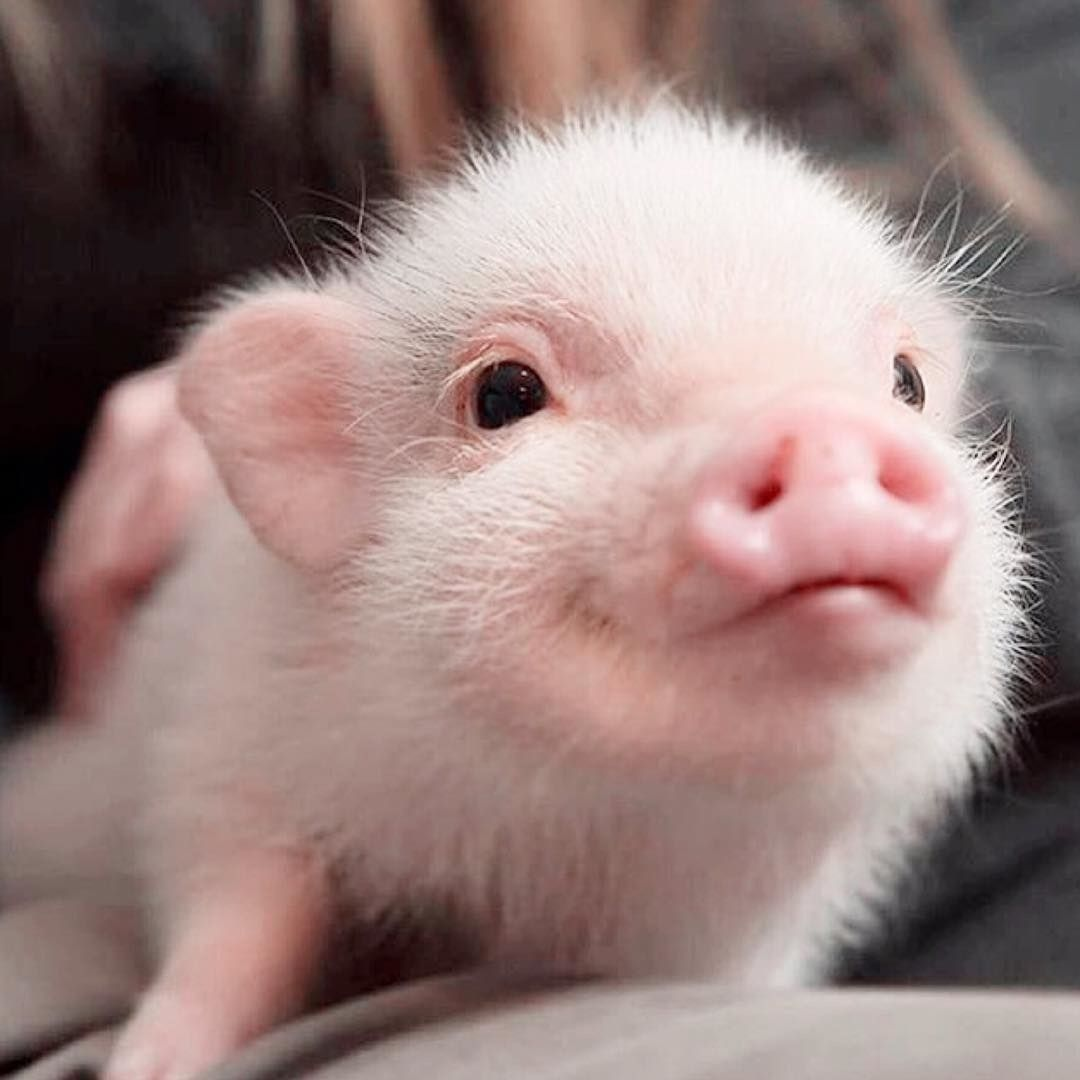
As always, we have to cutify everything if we can, but why pigs? Well, pigs can be explained in a very simple way: they are little meat-making machines that turn literally anything edible into meat. Those spoiled plants that we can no longer eat because they are going bad? Hurl it to the pigs, they’ll eat it, be fine, and now we have more meat to eat instead. So we could reuse slightly spoiled stuff by giving it to the pigs and then get delicious meat. And for all the non-vegans/vegetarians, who doesn't like good bacon? And pigs are very… fecundal. They reproduce like mad, so keeping a population going is super easy.
Now, chickens and cows. I am doing both because they are somewhat similar in that a cow and a chicken have one big thing in common: they regularly produce an edible product that doesn’t require killing the animal. Sure, we can and do kill them anyway because it is meat. But what do they produce? Milk and eggs! Those are produced daily so we can have them fresh every day and not worry about spoilage. Certain kinds of bulls have also been useful for labour in the fields, but it is not their primary purpose. Cows and chickens usually have a very skewed sex population for many reasons… one reason.
And finally, we have donkeys and horses. I put these together because they are closely related. Donkeys have been primarily useful to extract labour–pulling plows and much else, which is great! A bit of food in exchange for better plowing? Seems fair to me! And horses… They were game changers. A human jogging for a day, at a sustainable pace, can only get so far, but a horse going at its max sustainable rate? Boy, they can get so much further! And at max speed? No human can run away then. Honestly, it amazes me that humans ever managed to domesticate horses at all because they run and jump like mad. But we did, and here we are today. They were very good for pulling and speed, like pony express style relay systems were built on using horses at fixed distances, go max speed to the next station, switch to a new rested horse, off at max speed again, and keep at it. You can cover huge distances then!
These are not all the domesticated animals–we have llamas among many others–but I pick these for a reason that will come up soon.
A thing to note is that a lot of these examples are based on today’s animals capabilities, but they would have had lesser of it back in the day. Even then, it is still worth it, and we selected over time for more and more of those properties that helped us.
Dom-anne-sticating anne-imals
The puns are getting out of h-anne-d! But such is life. Well, how does one get an animal domesticated? It all boils down to really one thing that has many paths to it. What is that one thing? Taming the animal. Taming an animal is different from domesticating in that a tamed animal is one that is wild but has been captured and then learned to co-exist and live with humans and can be quite content with it. But a tamed animal can easily F off and live life in the wild and not need humans. Domesticated animals generally NEED sophonts to survive. But tamed animals became domesticated over MANY generations. One important thing to remember is that not animals are domesticatable at all, and some cannot even be tamed.
So what are the ways to tame an animal? The first and most obvious one is capturing the animal against its will. You see the animal in the world, and then one way or another, either wrestle it into submission or use other tools in order to get it to come with you. Though I do like the mental image of Stone Age humans finding wild boars in the wild and running after the boar and then leaping onto the boar and they wrestle in the mud. Then the little piggy gives up and is carried away defeated. This is also where the horse comes in. You didn’t need to capture ALL the horses; because of their family structure, you only needed to capture the head horses and the rest came without question. This is also why zebras cannot be domesticated. If one of them are captured, the rest goes, “You’re on your own!” and sod off. Much more work… way too skittish.
The second way has been strangely popular in a lot of cases, that is when the animal comes to us instead. They realise slowly that those hairless apes are not dangerous and can be kind if you don’t take the things they value. So they approach and start interacting with people, and over time become more and more tame, and eventually entirely domesticated.
Those are the two large ways to get an animal tamed (and eventually domesticated), but before we move onto Anne’s favourite part, here is a short list for if the animal is domesticatable.
An animal can be domesticated if it is:
Feedable - Generally not carnivores, though exceptions exist
Friendly - If it’s too hostile, it will kill you
Fecund - Very horny and not picky in how it reproduces, nor takes too long when reproducing
Families - No one likes an asocial psychopath, animals are no different.
Success of Civilisations
Let’s be honest here, civilisations have not been equally successful in the grand scheme of things. All civilisations and cultures are equally valid as long as they don’t violate human rights and dignity. Though let’s be honest on that, too–before 1900, there were literally no attempts by anyone to even remotely care about anything close to those in a universal manner.
But if we are to take a pivotal moment in history, the discovery of the Americas, or the new world, and compare how colonialization played out in the new world versus the old world, we can see several key differences that all stem back to domesticated animals. In the old world, there were greater populations that could fight back and even to varying degrees had enough technology to make the colonisation process much more of a hassle. India made it such a hassle, in fact, that the primary method to colonise them had to be a divide and conquer method. Tactics and strategy led to the colonisation more than raw power.
In the new world however, the story in rough strokes was more of a steamrolling effect where Europeans came and had little resistance to speak of. One reason for this I’ll talk about in the next section. But a big one was in fact the lack of domesticated animals in the new world. By pure evolutionary bad luck, the new world lacked many domesticatable animals. Llamas were one of the rare few, and all they got was drama from it, but anyone who has seen soap operas knows that people do love drama.
Jokes aside, llamas were like inferior donkeys, but worse donkeys are better than no donkeys. The fact that the old world had domesticated animals meant a lot of things. First of all is greater access to food, and greater access to food means more people. It also means that fewer people need to work to actually get food which helps spurring innovation. In every instance of a civilisation, it always happens that when access to more food for less work happens, greater innovations quickly follows because more people are free to think about seemingly irrelevant stuff and then have great ideas.
This helped lead to the vast technological difference that developed over time between the old and new world. I am talking about the old world because it is not all about Europe. The existence of horses also helped the old world form larger empires, and thus have greater amount of resources, that could be used for innovation, ship building, and much else.
This is somewhat historically illustrated by how many indigenous people greatly increased in many ways when they got access to more domesticated animals. They also became more dangerous to the invaders.
Hidden surprises of domesticated animals
Domesticated animals are not all good. And it is visible in one of the worst mass killings ever done and it was 90% unintentional. Namely the almost extinction of all indigenous people of the new world. This was caused by the innumerable plagues that the old worlders accidentally brought with them. They eradicated over 90% of all the new world's population and the Europeans didn’t have to do anything. But would it surprise you that Europeans did help the plagues along the way? I am sure it won’t…
If you look at history here, there were never any plagues that came from the new world. Sure syphilis and a few more diseases did come from the new to the old world. But they weren’t plagues. The difference between a disease and a plague is that a plague spreads rapidly and has high lethality while a disease lacks at least one of those.
So why did the old world have all those wretched plagues? Well, no surprise, it is the domesticated animals. All animals and multicellular life have diseases, including our little domesticated animals, and diseases are specialised to one species. That is why a sick dog sneezing in your face won’t make you sick! … 99.99% of the time.
As with everything biological, nothing is perfect, and by evolutionary happenstance, one of the bacteria or viruses that suddenly found themselves inside your body goes “oh, new place, wait, I can use this…” Yeah, by bad luck for us, it is not completely helpless inside of us, and by even more bad luck, the immune system doesn’t get it immediately. This means that it has the time to reproduce, and by evolutionary laws, it means there is a selective pressure on them to survive inside humans, or whatever sophont we’re talking about.
This is fortunately where most zoonotic, the fancy word for diseases that jump species, diseases die: in patient 0. They often die because the disease is going to do what it always does, and as in my disease post, it is generally bad practice for a disease to kill its host. A dead host is useless to live in and spread the bacteria or virus. So this disease does what it always did, which didn’t kill the original host…but that is no longer non-lethal in humans; it is likely very lethal. This is why zoonotic diseases often have high lethality initially.
But with one more lightning strike of bad luck, the zoonotic disease also learns how to spread from human to human and does so quickly because no person has any immunity. And a plague is born…
This is why the old world had so many plagues back in the day; all the domesticated animals for thousands of years meant we constantly had encounters with animals, each one a chance for a zoonotic disease transfer, and by numbers games, it eventually caused plague after plague after plague. The new world, with its larger lack of domesticated animals, didn’t have enough animal encounters in large quantities to mass-produce plagues.
Combine this with the increased population from domesticated animals, and you can see how bad it can get for the old world when it has huge, dense cities…
Summa Summarum
Domestication of animals was a game-changer for civilisations and people in the past and remains so to this day. We can just look at the pet market for that, and how we consume and use animals. But they are a double-edged sword for civilisations: you get more population and help doing work, and you also get plagues regularly that will never leave.
This is one of many things that help explain certain civilisations' success and “failure.” Of course, success here does not mean “Better,” just more people and longer lasting.
Is it worth it in the end? I’ll let you decide, but I love bacon, so you can guess my answer.
Want to dive into a discussion about Stellima or the art of writing on Discord? We’d love to have you! And if you have any topics you struggle with or that you would like to suggest for a future blogpost, we’re open to suggestions!
Interested in supporting our work? Join our Patreon and become a part of Stellima as a citizen of Mjatreonn! Or would you like to give us some caffeine to fuel our writing? Consider buying us a coffee at Ko-fi! Every contribution inspires our creativity and keeps us going. Thank you for your support!
Copyright ©️ 2026 Vivian Sayan. Original ideas belong to the respective authors. Generic concepts such as domestication are copyrighted under Creative Commons with attribution, and any derivatives must also be Creative Commons. However, specific exact phrasing are individually copyrighted by the respective authors. Contact them for information on usage and questions if uncertain what falls under Creative Commons. We’re almost always happy to give permission. Please contact the authors through this website’s contact page.
We at Stellima value human creativity but are exploring ways AI can be ethically used. Please read our policy on AI and know that every word in the blog is written and edited by humans or aliens.